Why Translating Image Text Manually Is Slowing Your Team Down
Manual image translation slows down marketing teams, delays campaigns, and increases costs. Learn why AI-powered image translation workflows are replacing manual editing.

Contributors

Subscribe to our newsletter
Introduction
I still remember sitting in a design review meeting where everyone looked exhausted. The campaign was ready. The visuals were approved. The copy was strong. But we were stuck — not because of strategy or creativity — but because we had to manually translate text inside 47 image banners.
Forty-seven.
Each banner had to be opened, edited, recreated, adjusted, proofread, and exported again. By the end of it, my team wasn’t brainstorming new ideas — we were nudging pixels.
Manual image translation used to be the only option. Designers relied on Photoshop, Illustrator, and repetitive copy-paste workflows to recreate localized assets.
The process sounded simple:
- Remove the original text
- Insert translated copy
- Adjust layout
- Export the image
But simple does not mean efficient. In today’s fast-moving marketing environment, manual image translation creates serious workflow bottlenecks. And if you are scaling campaigns globally, that bottleneck becomes a traffic jam.
Why Translating Image Text Manually Is Slowing Your Team Down
Manual translation may seem like a small task at first, but the effort multiplies quickly.
A typical manual workflow includes:
- Opening each image file
- Erasing the original text
- Copying translated content
- Adjusting layout and spacing
- Fixing font issues
- Exporting new versions
Now imagine doing that for 100 creatives across multiple languages.
The workload grows fast.
The Hidden Cost of Manual Image Translation
On the surface, manual editing looks harmless. But beneath the surface, it drains time and resources.
Time Drain
Each creative can take 10–20 minutes to translate manually.
| Number of Images | Avg Time per Image | Total Time |
|---|---|---|
| 20 | 15 minutes | 5 hours |
| 50 | 15 minutes | 12.5 hours |
| 100 | 15 minutes | 25 hours |
That is more than three full working days spent on repetitive editing.
Productivity Bottlenecks You Didn’t Notice
Manual workflows introduce friction across the entire team.
Designers Become Translators
Instead of focusing on creativity, designers spend time erasing and replacing text.
Marketing Teams Wait
Campaign launches get delayed because localized assets are not ready.
Revisions Multiply
If a copy change happens, the entire process must be repeated.
The Ripple Effect on Campaign Launches
Many teams delay regional campaign launches because localization is not completed on time.
Manual workflows simply do not scale.
As campaigns expand into new markets, the amount of work increases linearly while team size usually stays the same.
Why Translating Image Text Manually Is Slowing Your Team Down (In Practice)
Let’s look at a typical campaign scenario.
You have:
- 10 banner ads
- 3 social media creatives
- 5 email headers
Now translate them into:
- Spanish
- French
- German
- Arabic
That means:
18 creatives × 4 languages = 72 manual edits
And that is for a single campaign.
Common Manual Translation Challenges
Text Expansion
Some languages expand significantly compared to English.
German translations often grow by 20–30%.
Font Compatibility
Certain fonts support only Latin characters and fail when used with accented or non-Latin scripts.
Layout Breakage
Spacing shifts and alignment issues can disrupt the visual balance of the design.
How Manual Translation Impacts ROI
Manual translation has a direct cost.
If a designer earns $40 per hour and spends 25 hours translating images manually, the cost becomes significant.
| Hourly Cost | Hours | Total Cost |
|---|---|---|
| $40 | 25 | $1,000 |
And that is just for one campaign.
Multiply that by monthly campaigns and the cost increases quickly.
Emotional Burnout Is Real
The cost is not only financial.
Repetitive editing drains creative energy.
Designers want to build new ideas, not repeatedly replace text inside images. When teams spend too much time on manual production tasks, creativity and motivation decline.
What Manual Image Translation Really Means
Manual translation workflows usually result in:
- Limited scalability
- High repetition
- Increased risk of human error
- Slower turnaround times
And in global marketing, speed matters.
The Shift Toward AI-Powered Image Translation
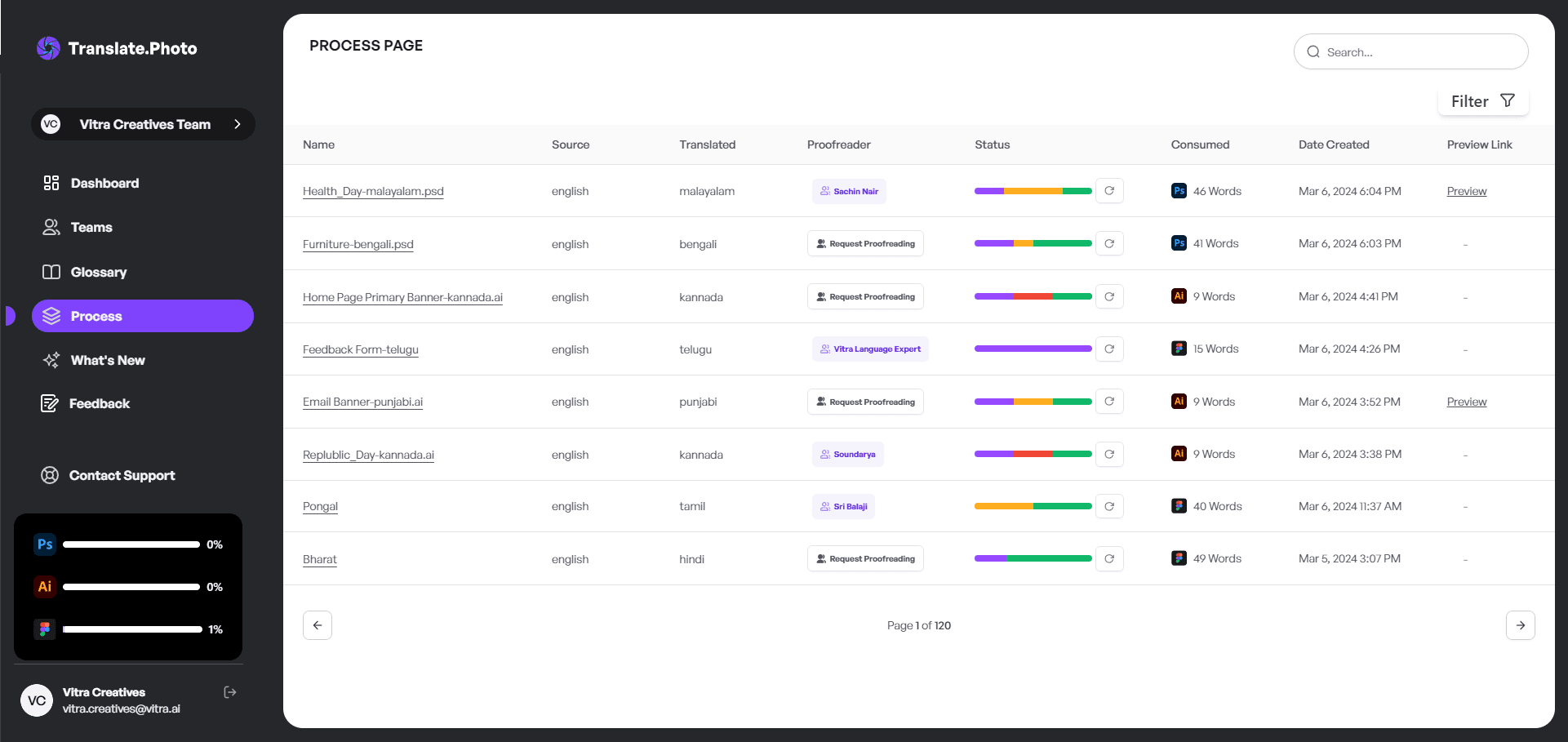
AI-driven platforms such as Translate.photo simplify the process.
Instead of manually editing each creative, the workflow becomes:
- Upload the image
- Automatically detect text using OCR
- Select the target language
- Review the translated image
- Export the final creative
What previously required hours can now be completed in minutes.
Comparing Manual vs AI Translation
| Factor | Manual | AI with Translate.photo |
|---|---|---|
| Speed | Slow | Fast |
| Scalability | Low | High |
| Consistency | Medium | High |
| Team Effort | High | Low |
Automation significantly reduces repetitive tasks.
Why Translating Image Text Manually Is Slowing Your Team Down in Global Expansion
Entering new markets requires fast localization.
Manual processes struggle when working with:
- Multiple languages
- Large creative libraries
- Ongoing campaigns
Automation allows marketing teams to scale content across regions quickly.
Real Example from My Workflow
Earlier this year, I localized 120 creatives across six languages.
The manual estimate looked like this:
120 creatives × 15 minutes = 30 hours per language
With automated image translation:
- Bulk upload
- Batch translation
- Central glossary
The entire process finished in less than a day.
Translation Memory Saves More Than Time
Manual editing often introduces small inconsistencies.
For example, brand taglines or product names might change slightly across images.
Translation memory helps maintain consistency by storing:
- Brand taglines
- Product names
- Industry terminology
This ensures messaging stays consistent across campaigns.
Manual Translation and Error Risk
Human error becomes more likely with repetitive editing.
Common mistakes include:
- Missed text blocks
- Cropped characters
- Incorrect right-to-left alignment
- Font substitution errors
Automation reduces these repetitive errors while still allowing human review.
The Opportunity Cost Nobody Talks About
While designers spend time manually editing images, they are not working on:
- Testing new creative concepts
- Optimizing campaigns
- Building marketing strategy
- Analyzing performance metrics
Manual workflows consume time that could be used for higher-value tasks.
Signs Your Team Is Stuck in Manual Mode
Consider these questions:
- Are designers spending hours editing text inside images?
- Do campaigns get delayed because localization is incomplete?
- Are translations inconsistent across creatives?
- Does scaling campaigns feel overwhelming?
If the answer is yes, manual workflows are likely the bottleneck.
Scaling Without Increasing Headcount
Hiring more designers to handle manual translation is rarely sustainable.
Automation allows teams to:
- Launch more campaigns
- Enter new markets faster
- Maintain brand consistency
- Reduce turnaround times
All without expanding the team.
Why Translating Image Text Manually Is Slowing Your Team Down (Strategically)
Manual workflows limit growth.
They tie creative teams to repetitive tasks and slow experimentation.
In digital marketing, the teams that move fastest usually win.
The Smarter Workflow
After switching to automated image translation, several things changed:
- Designers spent less time editing
- Campaigns launched faster
- Brand consistency improved
- Team stress levels dropped
Instead of reacting to localization delays, teams can proactively expand into new markets.
What Happens When You Remove the Bottleneck?
When manual image translation disappears:
- Creative production speeds up
- Global marketing becomes easier
- Team morale improves
- Campaign ROI increases
That shift can transform how marketing teams scale internationally.
Our blog
Lastest blog posts
Tool and strategies modern teams need to help their companies grow.

Image optimization
Balancing Image Quality and Load Speed for Portfolio Links
Learn how to balance high image quality and fast load speed for portfolio websites using smart compression, responsive images, and performance optimization techniques.

Image-optimization
How to Change Image Dimensions Without 'Squishing' Your Subject
Learn how to change image dimensions without distorting your subject by using proportional scaling, smart cropping, and canvas expansion techniques.

Image translation
How to Translate JPEG Images
Learn how to translate JPEG images accurately while preserving layout, brand tone, and design quality with a smarter AI-powered workflow.
Join Our Satisfied Clientele
- Global Reach, Local Impact
- Efficiency Redefined
- Optimized SEO, Elevated Traffic